The Analysis of Practice
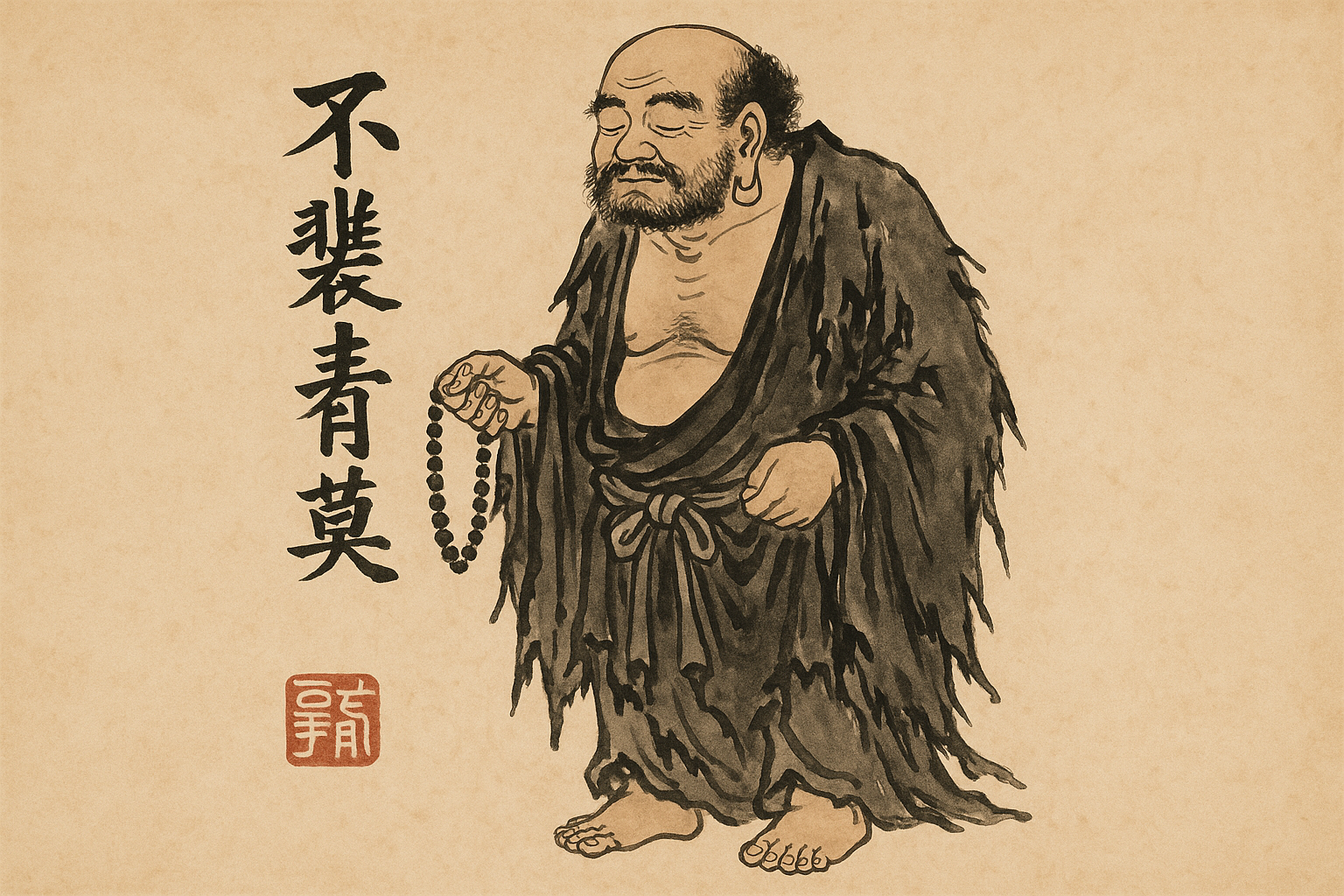
Practice begins with a twofold intuition: the selflessness of the person and the selflessness of things. When a spiritual genius realizes that neither “self” nor “world” possesses intrinsic nature, she abandons both falseness and misplaced authenticity in every duality—
being vs. non-being, existence vs. nothingness.
This letting-go is achieved through three concentrations:
the concentration on voidness, which exposes the unreality of constructed phenomena;
the concentration of wishlessness, which reveals the contingent, relative world;
and the concentration of signlessness, which points to perfect reality beyond conceptual markers.
These are not yet ultimate, but they carry the mind toward transcendent intuition.
A knower of import understands that teachings are like boats.
They are precious while crossing the river,
but once the far shore is reached, they are not to be carried on one’s back.
Because he refuses complacency with mere learning,
he becomes a genuine knower of Dharma—
one who studies not to collect knowledge but to cross beyond it.
Having penetrated the two forms of selflessness through intuitive grasp of meaning
and intuitive grasp of the teaching itself,
the practitioner then cultivates the corresponding realizations
so that wisdom becomes stable, embodied, and unshakeable.
This marks the movement from the ordinary state
into the path where insight becomes a transforming force.
At this point she attains transcendent, unexcelled intuition—
the intuitive wisdom that belongs to the first awakened stage,
known as the joyous stage.
Here she becomes equal in nature to all spiritual geniuses who stand on that ground,
moving in harmony with the awakened in both conduct and realization.
Once the addictions abandoned by insight have been terminated,
the practitioner turns fully toward meditation
in order to uproot the remaining objective obscurations.
Insight purifies the inner distortions;
meditation clears the external appearances that hold perception captive.
Finally, she brings together situational intuition—
the wisdom that arises in the structured context of each stage—
and nonconceptual intuition,
the direct, thought-free knowing that reveals truth without any mediation.
By coordinating these two inseparable forms of awareness,
she cultivates the harmonious realizations that carry her through the remaining stages of the path.
In this integration, the practice becomes whole.
Insight and meditation support one another,
and the movement toward awakening proceeds without obstruction.
Comments (0)
Sign in to join the conversation
No comments yet. Be the first to share your thoughts!